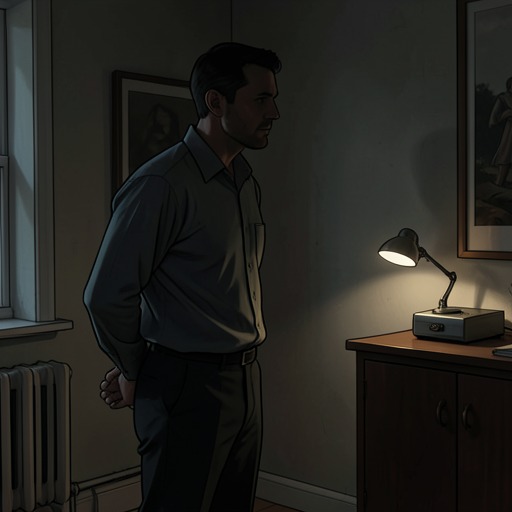
Michael withholds Hanna’s illiteracy from the court
The ReaderMichael withholds Hanna’s illiteracy from the court at first, despite seeing how her inability to read has shaped the trial and damaged her defense. His eventual decision to approach the presiding judge is not a clean act of rescue: he must weigh the possibility of a less severe sentence against Hanna’s determination to preserve her secret, and he cannot resolve that conflict by speaking to her herself.
The disclosure he considers
As the trial proceeds, Michael comes to understand Hanna’s behavior in court differently from the other defendants and the prosecution. Her short answers, apparent lack of strategy, and failure to engage with the indictment and the manuscript do not, in his view, demonstrate simple arrogance or incorrigibility. He recognizes that her illiteracy has prevented her from familiarizing herself with the case against her, and that this incapacity has significantly compromised her defense. The other defendants’ effort to make her appear the principal guilty party makes the consequences of that disadvantage more acute.
Michael considers telling the judge what he knows. He believes that even if the disclosure did not persuade the judge outright, it would oblige the court to investigate further. He expects that Hanna would still be punished, but perhaps less severely: she would go to prison and might be released sooner. The possibility matters because he believes that an earlier release is what she has been fighting for. His contemplated intervention is therefore not an attempt to establish her innocence, but to make the legal assessment of her responsibility less distorted by a secret that has shaped her ability to defend herself.
Hanna’s secret and the limits of intervention
The prospect of helping Hanna brings Michael up against the fact that she does not want help on those terms. He understands that revealing her illiteracy would expose her to the very judgment she has spent her life avoiding. She is not willing to obtain a better legal outcome at the cost of having her self-image overturned; Michael believes that she could have made that trade herself, but did not. In his reasoning, her sense of self is worth more to her than years of imprisonment.
That recognition does not settle the moral question. Michael asks whether someone should intervene when another person is moving toward self-destruction while remaining blind to the cost. He considers comparisons involving a patient who hides drug use, or a defendant whose shame conceals information relevant to a trial. These examples frame the issue not as whether the hidden condition deserves shame, but as whether someone else should disclose it when the person concerned refuses. In Hanna’s case, correcting the record could serve justice while also violating the choice by which she protects herself.
Michael’s father offers a principle rather than an easy answer: when responsibility has accrued or been inherited, a person who sees what another cannot should try to open that person’s eyes, while leaving the final word to them. Crucially, he says Michael must talk to Hanna, not to someone else behind her back. Michael recognizes the force of that distinction, but cannot imagine how to tell her that he has seen through her lifelong lie, that prison remains a just consequence of what she did, and that she may still have a future beyond it. He cannot offer her that future with any confidence, and he cannot face her to say the rest.
From silence to the judge
Michael ultimately cannot endure doing nothing. He goes to the presiding judge, although he cannot make himself visit Hanna. His action is driven partly by his stated wish to prevent a miscarriage of justice, but he also admits that justice is not his only concern. He cannot leave Hanna as she is, or as she wants to be; even indirectly, he wants to interfere with her and exert an influence over her. That admission complicates the apparent fairness of his intervention: the decision concerns Hanna’s defense, but it is also bound up with Michael’s personal inability to accept her chosen silence.
The court had already been considering the evidentiary problem surrounding the camp report. The defendants collectively discussed what to write because they did not want to place blame on those who had left, or expose themselves to charges of wrongdoing; when a prosecutor proposed comparing handwriting, Hanna admitted that she had written it. The documentary evidence and the defendants’ conflicting accounts make the trial’s assignment of responsibility uncertain, while Hanna’s own concessions expose her to blame. Michael’s knowledge of her illiteracy could alter how the court interprets her conduct and defense, but it cannot undo the killings or settle every uncertainty about what each guard did.
The evidence does not make Michael’s choice a straightforward correction of the trial’s facts. The surviving mother and daughter could testify about their experience, but they had not seen what happened outside the church; the report, in turn, suggested that guards stayed behind and kept its doors locked, without naming the defendants. Michael believes Hanna has been made to bear more guilt than she should, not that she is innocent. The distinction he wants the judge to consider is one of degree and of fairness in the proceedings, rather than a denial of her culpability.
After the intervention
After speaking with the judge, Michael listens as the judge discusses his studies and the trial. The judge says Michael can return with further questions or seek advice, and asks to hear the seminar group’s evaluation of the trial. Michael then takes a slow rush-hour train, watching passengers change and the landscape pass outside. He feels nothing: the hurt of having been left, deceived, and used by Hanna no longer presses on him, and he no longer feels compelled to meddle with her. The numbness that had accompanied his experience of the trial settles over his recent emotions and thoughts, allowing him to return to ordinary life.
The verdict comes at the end of June. Hanna receives a life sentence, while the other defendants receive prison terms. The account does not establish that Michael’s disclosure changed the judgment or achieved the earlier release he had imagined. Instead, the episode ends with the unresolved distance between his intervention and its outcome: he acts because silence has become unbearable, yet cannot give Hanna the chance to answer him directly, and the court’s sentence remains severe.
Narrative and ethical significance
The episode turns on a gap between knowing a fact and having the right, or the ability, to use it. Michael’s knowledge of Hanna’s illiteracy can help explain why she failed to defend herself effectively, but disclosure would also violate the boundary she has drawn around her secret. Her refusal is not merely an obstacle to Michael’s plan; it is a choice he recognizes as consequential, even while he finds it costly and self-destructive. His eventual appeal to the judge therefore preserves the conflict rather than resolving it.
The legal record, witness testimony, and Michael’s private knowledge each illuminate different limits of the trial. The survivors could speak to what they experienced, the camp report implied a course of events without clearly identifying every participant, and Hanna’s admission that she wrote it made her concessions damaging to herself. Michael’s proposed disclosure adds another kind of evidence: not a rebuttal of the crimes, but an explanation of why Hanna could not engage with the case in the way the court expected. The scene’s moral tension lies in the difference between making that explanation available to the court and respecting Hanna’s wish that it remain undisclosed.
Michael’s conduct also exposes the personal dimension of his appeal. He describes it as an effort to ensure justice both for and against Hanna, but recognizes that he wants an influence over her even when he cannot reach her directly. Going to the judge instead of Hanna fulfills part of his wish to act while evading the difficult conversation his father recommends. His intervention is thus simultaneously an attempt at fairness and a continuation of the distance, secrecy, and indirect communication that mark his relationship with her.